
Kazuo Ohno - In His Own Words
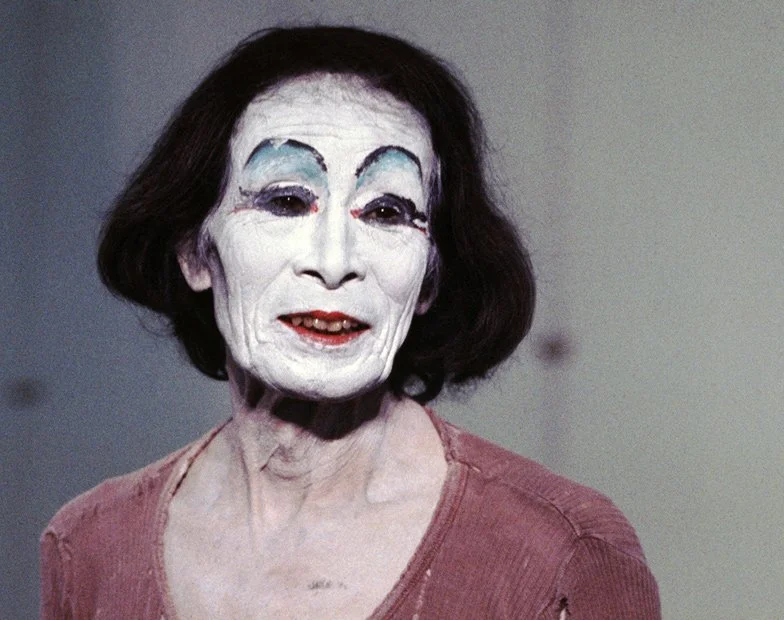
Template:Film camera, CC BY 3.0 , via Wikimedia Commons
From Kazuo Ohno’s World: From Without and Within
“"The dancer's costume is to wear the universe."”
A class with Kazuo Ono is no ordinary class. When does the class begin? When we take the train from Tokyo to Yokohama? When we climb the path which leads to the house on a hill? While we sit around the table in his studio, drinking tea and listening to him before beginning to work?
Sitting crosslegged in his armchair, he speaks, "My art is an art of improvisation. It is dangerous. To succeed, one must first reach the very depths of the human soul, and then, express it ..."
He says that he doesn't like to teach, that he doesn't know how. And this is true. He doesn't "teach." He nourishes; he guides; he provokes; he inspires. This is undoubtedly the difference between a "master" and a "teacher."
The class begins. He assigns a subject for improvisation. The "dead body" is a theme he often suggests. "What could be the life of that which is dead? It is this impossibility that we must create." He explains that for his dance, we must not try to control the body, but to let the soul breathe life into the flesh.
He adds: "Be free! Let go!" Being free is not doing what we want or what we think. On the contrary, it means being liberated from thought and will. "You are happy because you are free. You smile: a flower blossoms in your mouth."
He approaches a student who is holding his arms above his head. He indicates the limits of space thus formed and tells him, "There is an entire universe here." He then adds, "Paradise is at your fingertips." To another he hints, "I am glad to be alive!" Then for all to hear: "You are glad to be alive!"
He later explains that the illogical is liberating, that the impossible opens new paths. "Today, you will dance Hamlet in a world of frogs."
Although he will sometimes correct a pose or explain the elementary movement of the body, he generally avoids imposing the slightest technique; it is up to the student to create whatever techniques are necessary. Ono is there to open up the imagination, to help discover the soul. He guides the student so that he can become like "the creator of the world, he who has no identity, he who existed before the appearance of the individual. Then, all is but a game."
Jean Viala and Nourit Masson-Sekine (1988) Butoh: Shades of Darkness. ISBN4-07-974630-X
In reply to the often asked question why he performs dressed as a woman, Kazuo has repeatedly stated: “My intention in dressing as a woman onstage has never been to become a female impersonator, or to transform myself into a woman. Rather, I want to trace my life back to its most distant origins. More so than anything else, I long to return to where I’ve come from.”
What can you teach? Not art, that’s impossible. Contrary to the common view, art cannot be taught. I believe that a piece of work comes out naturally from a human being just like one human being comes out of another… You must have life coming out of you.”
from "Kazuo Ohno Doesn't Commute," "Selections from the Prose of Kazuo Ohno," and "Performance Text: The Dead Sea," The Drama Review, Summer 1986.
“Alive, in each and every one of us, are countless individuals whose lifetime experiences, joys, sorrows, angers, doubts, and so forth have been successively passed down from one generation to the next. The physical form I assume now is but the fruit of what I’ve inherited from those who have existed before me. What, you might ask, has become of our ancestors’ ideas and emotions? Where do you suppose our creativity springs from? There’s no way that it springs forth from our finite and limited knowledge of life. I’m not the only one who has ever existed; our ancestors haven’t just died and vanished into oblivion. We’re not the fountainhead of our creative powers. Down through the ages our ancestors’ emotions and ideas have accrued and ingrained themselves in the imaginations of each successive generation.
That’s why whenever we start to unravel the threads of life’s tapestry, we ultimately reach the creation of heaven and earth. Each thread leads us deeper into the past. Don’t we dream? We certainly do so. Do our dreams explore only our finite experiences? And what about children, whose dreams do they dream? Our dreams not only unveil the world we’ve known from birth, but also the long period stretching back to the genesis of the earth. Our progenitors densely inhabit our souls.”
“In the Noh theatre, a player employs nonmovement and nonaction in his quest to create a rapport with the spectators. The ideal is to dance without moving. In fact, such sparseness of expression is an effective means to evoke the world of spirits, for inaction, more than physical movement, affects us on a much deeper level… Anyway, what’s the purpose of our being here? Ultimately, aren’t we here to link hearts? It’s a difficult challenge. Bear in mind that restraint plays an essential role in creating your onstage presence.”
“There’s an infinity of ways in which you can move from that spot over there to here. But do your movements allow us to feel your spirit? Have you figured those movements out in your head? Or are we seeing your soul in motion? …the essential thing is that your movements, even when you’re standing still, embody your soul at all times.”
“We don’t get anywhere by remaining continuously on the move. At some stage along the way we need to stop and rest. Once we do so, a tiny hut unexpectedly appears from out of nowhere, a sanctuary in which we can refresh ourselves and take stock of our lives. There’s no need to continue without rest. What’s to stop us from just standing still by the side of the road for a while? …As human beings, we don’t grow while on the move, but during those dreams we inhabit as we stop and rest for a while. Isn’t it at such times that our souls evolve?”
Extracts from “Workshop Words,” Kazuo Ohno’s World, trans. John Barrett
As defined by Ohno himself: “Basically, ‘butoh’ means to meander, or to move, as it were, in twists and turns between the living and the dead.”
“The best thing someone can say to me is that while watching my performance they began to cry,” he once said. “It is not important to understand what I am doing; perhaps it is better if they don’t understand, but just respond to the dance.”
“An authentic expression only emerges when body and soul reach crisis point. Look closely at plants. When in blossom, flowers are petal-laden right to the very tip of their limbs. But take a look at your fingertips: they’re lifeless. If your dance is to come to life in the same way a flower blossoms, then be flower-like. Look at trees! From the roots to the tip of their branches, they’re vibrantly expressive.”
“As soon as someone says to me that they understood my performance, I become instantly discouraged.”
A Message to the Universe by Kazuo Ohno (1998)
“On the verge of death, one revisits the joyful moments of a lifetime. One’s eyes are opened wide gazing into the palm, seeing death, life, joy and sorrow with a sense of tranquillity. The daily studying of the soul, is this the beginning of the journey? I sit bewildered in the playground of the dead. Here I wish to dance and dance and dance and dance, the life of the wild grass. I see the wild grass, I am the wild grass, and I become one with the universe. That metamorphosis is the cosmology and the study of the soul. In the abundance of nature, I see the foundation of dance. Is this because my soul wants to physically touch the truth? When my mother was dying, I caressed her hair all night long without being able to speak one word of comfort. Afterwards, I realized that I was not taking care of her, but she was taking care of me. The palms of my mother’s hands are precious wild grass for me. I wish to dance the dance of wild grass to the utmost of my heart.”
“I dance at the place where the large cosmos meets the small cosmos. I stand in the large cosmos and everywhere my hand reaches is the small cosmos. I understand where the meeting place is.”
“Inevitably, one has to feel a spiritual dimension, a sense of prayer, rapture and the spirit vibrating for a work to constitute good art: What matters is whether it addresses our universal condition. In other words, Butoh both responds to and expresses our inner realities through physical expression. That means that it engages with the essence of human existence. In doing so, one could say that it ultimately renders love in its quintessential form. The idea of a dance unfolding like the birth of life has been my lifetime’s wish. I believe that even those bodiless spirits must express themselves by means of the human body.”
